
A One-Person Billion-Dollar Company Is Born, Proving Altman Right
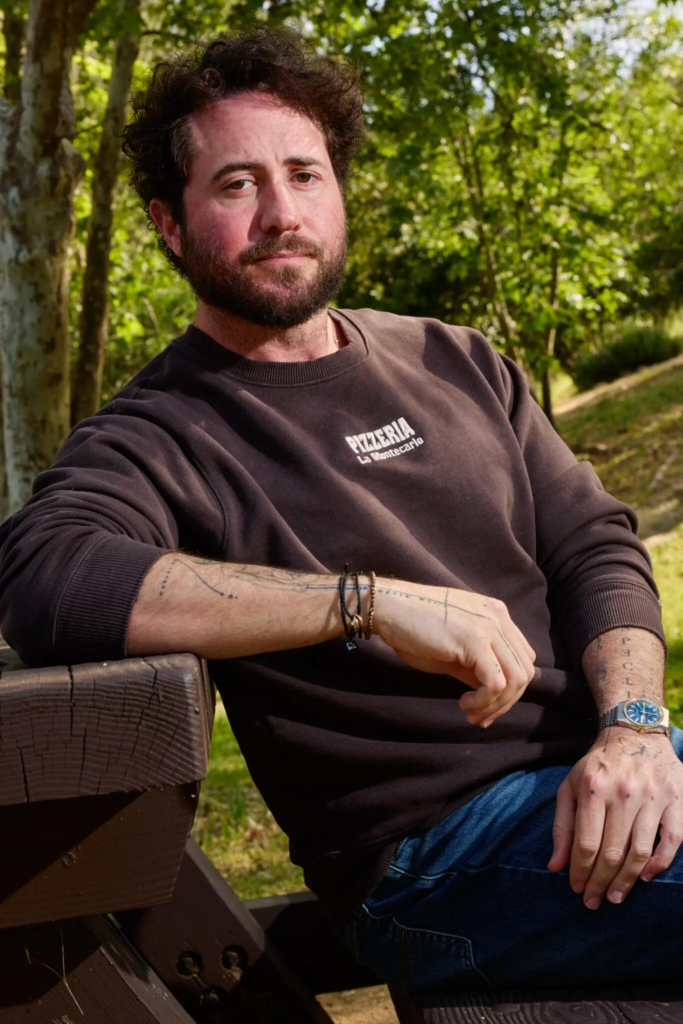
Early today, 41-year-old tech visionary Matthew Gallagher from Los Angeles redefined what it means to be a “super-individual” in the AI era.
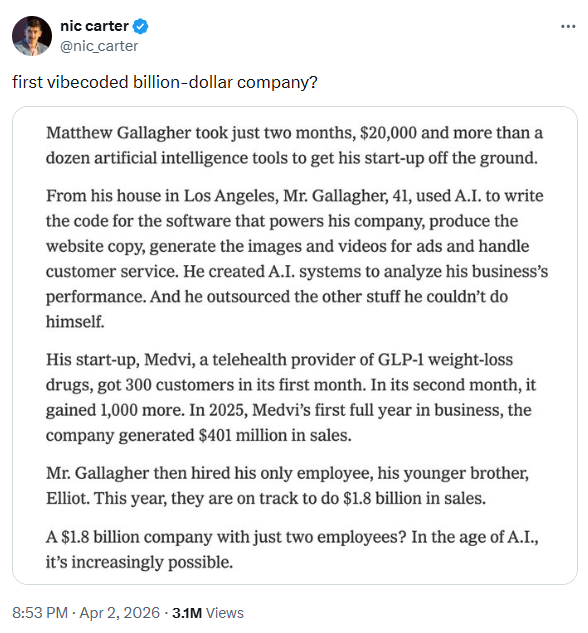
In just two months, with a mere $20,000 in startup capital and a team of about a dozen AI “employees,” he built a medical company projected to generate $400 million in annual revenue.
A Brutally Efficient “AI-First” Operation
Matthew’s operating model is ruthlessly efficient: foundational code is written by AI; all front-end web copy, ad graphics, and promotional videos are AI-generated. Even complex, labor-intensive systems like the “business analytics dashboard” and 24/7 customer service are fully managed by AI agents.
In its first year, this “one-man company” skyrocketed to $401 million in revenue. It was only recently that Matthew hired his first and only full-time employee—his younger brother, Elliot.
This year, the brothers have set an even more staggering goal: leading their vast “Agent Army” to target $1.8 billion in revenue.
The news instantly set the internet ablaze. This 41-year-old’s radical experiment has left Silicon Valley in awe, earning a personal shout-out from Sam Altman himself.
The One-Person Billion-Dollar Company: Altman’s Prophecy
In 2024, Sam Altman made a bold prediction in an interview: the future would see a one-person billion-dollar company. At the time, it sounded like pure fantasy.
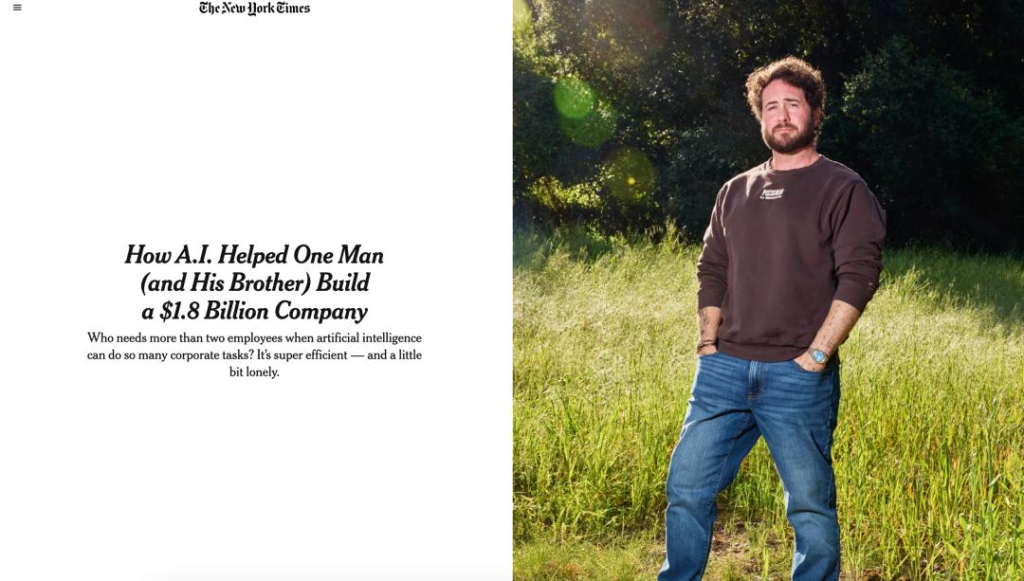
Yet, just two years later, 41-year-old Matthew Gallagher has turned this prophecy into reality through a fiercely efficient entrepreneurial experiment. A detailed report by The New York Times today dropped like a bombshell in Silicon Valley, exploring one question: How did AI help one man (and his brother) build an $1.8 billion company from scratch?
The Genesis: September 2024
With only $20,000, Matthew quietly launched his telemedicine company, Medvi, in September 2024, targeting the lucrative GLP-1 weight-loss drug market. No fancy office, no large startup team. Matthew worked from his Los Angeles apartment, expertly commanding his “AI Army”:
- Coding & Development: Handled by AI programmers like ChatGPT, Claude, and Grok.
- Copy & Visuals: Midjourney and Runway mass-produced web pages, posters, and videos.
- Customer Service: The ElevenLabs AI voice assistant handled all communication, 24/7.
- Business Analytics: A custom AI analytics system monitored company performance in real-time.
His core strategy was crystal clear: delegate everything possible to AI. He even cloned his own voice to have AI handle personal appointment calls, freeing up all his focus for work.
$65M Net Profit, Outperforming a Public Company
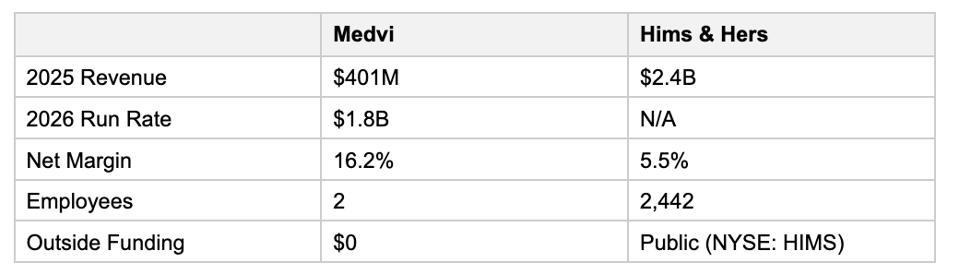
The first month brought 300 customers. The second added 1,000. By the end of 2025, Medvi’s annual sales hit $401 million, serving 250,000 cumulative customers. Projections for 2026 soar to $1.8 billion. The entire company’s official headcount? Just two: Matthew Gallagher and his brother Elliot.
Medvi’s financial data shows current daily revenue exceeds $3 million, with a 2025 net profit margin of 16.2%, approximately $65 million. In contrast, the publicly-traded company Hims & Hers achieved only a 5.5% net profit margin the same year—with 2,442 employees.
Upon seeing the report, Sam Altman replied in an email suggesting he “probably won” that CEO bet and expressed a strong desire to meet this person.
The Self-Taught Programmer’s Rise
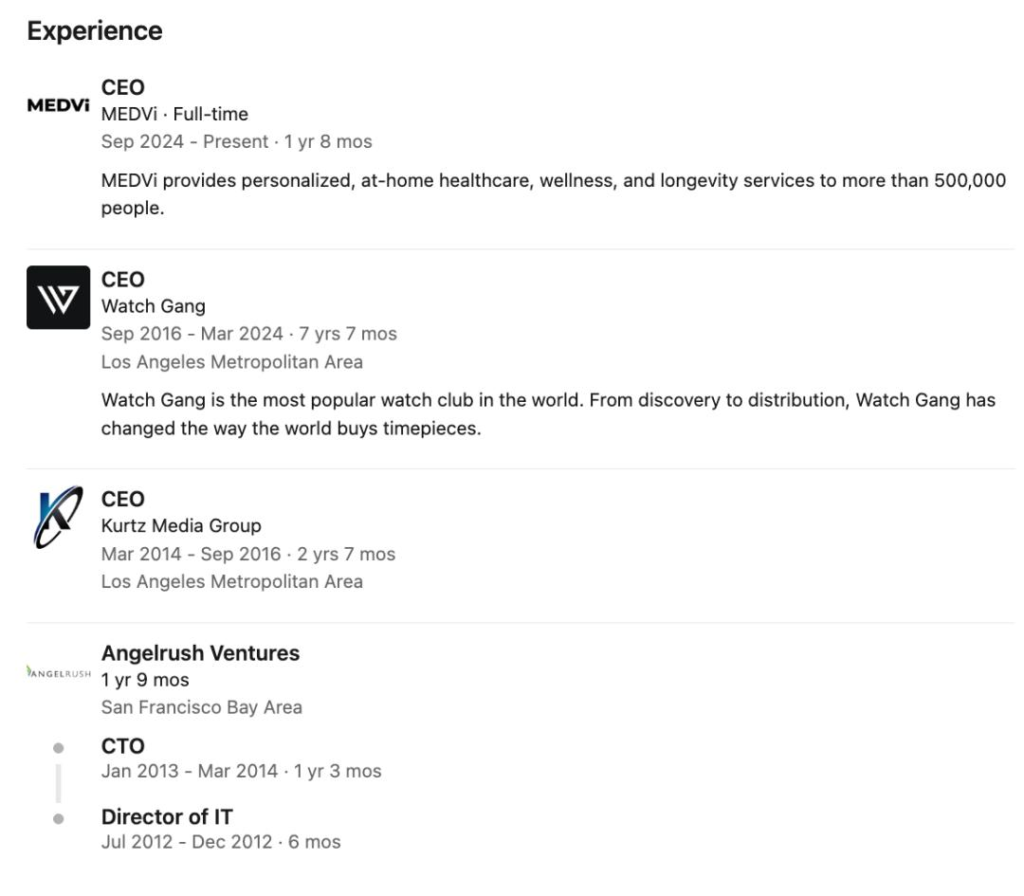
Matthew’s childhood was far from privileged, moving between motels and cars before settling in Cincinnati at age 12. His uncle gave him a laptop, and he taught himself to code, his first project being a fan page for “Weird Al” Yankovic. As a teen, he built websites for local businesses and sold candles and samurai swords on eBay. At 18, he sold a “web hosting business” he built for $6,000.
He attended two colleges but didn’t graduate, moved to Los Angeles in 2010 to try acting, and eventually returned to coding. In 2016, he founded Watch Gang, a watch subscription box company. It employed 60 people, had a fanbase and traffic, but never turned a real profit.
After ChatGPT’s release in 2022, Matthew dove into AI tools. Two years later, he met Jiten Chhabra, co-founder of CareValidate—a platform providing a “telemedicine infrastructure bundle” including online doctor networks, prescription systems, and pharmacy fulfillment. Another similar platform was OpenLoop Health.
Matthew spotted the opportunity: use AI to handle branding, marketing, and customer service, while outsourcing doctors, pharmacies, compliance, and fulfillment to these platforms. He chose to enter via the then-booming GLP-1 weight-loss drug market.
Chaos and Growth: Selling at AI-Quoted Prices
After launch, Medvi’s growth stunned its partners. CareValidate’s Chhabra recalled asking Matthew if he had “a team hidden somewhere.” The answer was no.
OpenLoop CEO Jon Lensing remarked that Matthew’s “native language seems to be AI.” Of course, there were stumbles. The AI chatbot would randomly invent drug prices, and Matthew chose to honor those prices and sell. It also suffered “hallucinations,” telling customers Medvi sold hair-loss medication when it didn’t. Most critically, if a customer insisted on speaking to a human, the chatbot was set to forward the call directly to Matthew’s phone, leading him to answer over 1,000 customer service calls himself.
Once, after making a small website update and going hiking, he got a call from his ad agency reporting zero new orders for an hour. Realizing his update broke something, with no one to help fix it, he had to sprint down the mountain back home. That outage cost him about 200 potential customers.
Targeting $1.8B, But Facing Loneliness
Burned by his experience with Watch Gang, Matthew is extremely wary of “hiring.” Those 60 employees didn’t help the company grow but increased costs and slowed decisions. Thus, Medvi’s structure is ultra-lean: two contract engineers, plus his brother Elliot, who officially joined in April 2025. Elliot’s main role is filtering communications so Matthew can focus. Matthew also uses an AI voice clone to handle scheduling calls, saving more time for work.
Apart from showering, sleeping, and time with his two kids, he dedicates almost all his time to Medvi. As the company grew, he gradually switched some professional tasks from AI tools to real humans: legal work from LegalZoom to a law firm, finance from AI bookkeeping to an accounting firm. But core operations still heavily rely on AI.
In February 2026, Medvi launched a men’s health line, including ED medication, gaining 50,000 customers in the first month, projected to surpass the GLP-1 business within four months. In March, healthy meal delivery was added. Plans include women’s health, hormone therapy, hair loss, supplements, and skincare.
Matthew considered acquisitions for expansion but realized he could build just as fast with AI. Venture capitalist Kobie Fuller of Upfront Ventures advised him: if you don’t need the money, don’t raise funding. To date, Medvi’s total profit is between $70-$80 million. Matthew has put $1 million into a foundation, donating to a Los Angeles cat rescue and planning to support nonprofits helping homeless youth, aiming to eventually channel most of Medvi’s profits through the foundation.
“This is the first time in my life I’m not anxious about survival,” said the man who grew up in trailer parks. However, the super-lean team has its cost—he admits to starting to “feel lonely.” To cope, Medvi began assigning human account managers to some clients. These seven contract managers, each handling hundreds of client relationships, remember personal details like birthdays and kids’ names. How do they manage this scale? With AI, of course.